
An ally for the health and comfort of your animals

The BVS is an autonomous robot designed for vacuuming manure in dairy barns. Thanks to its vacuum system and programmable passes, it helps keep floors clean, reduces moisture, and improves the daily comfort of the animals.

The BVS also means less manual labor, consistent cleanliness, and fully autonomous operation on a daily basis.
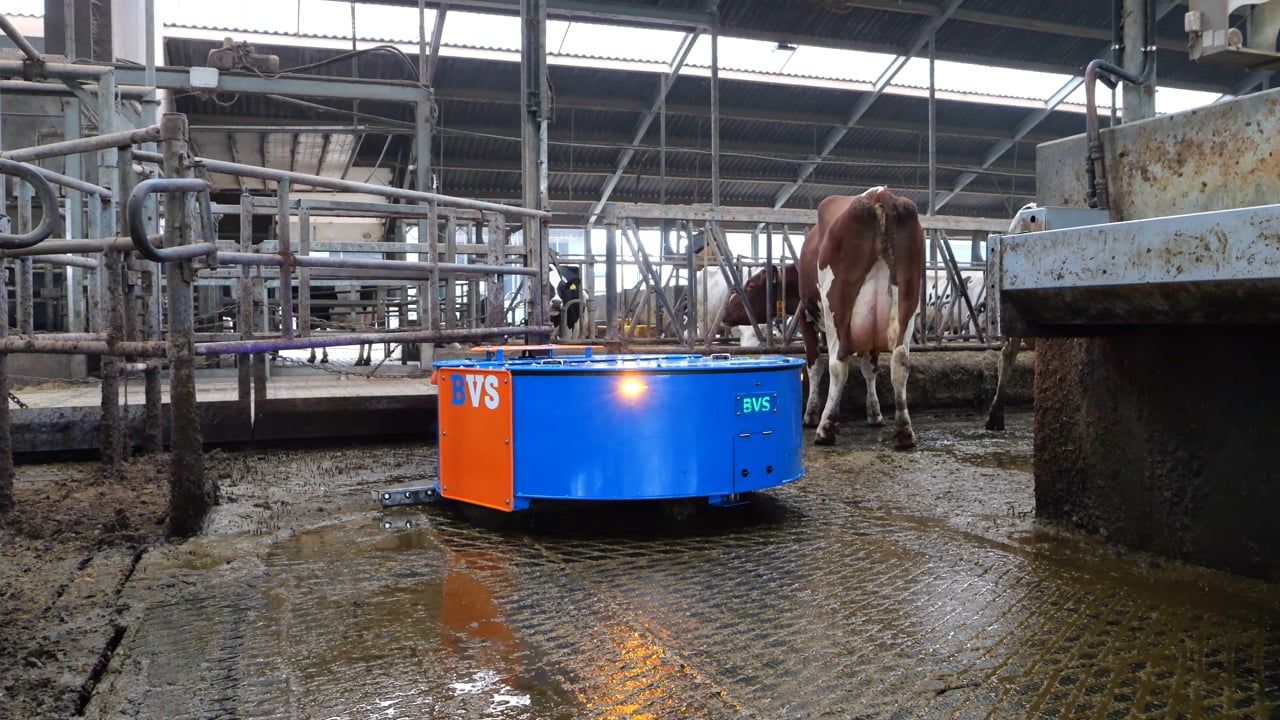
HOW IT WORKS

The BVS uses a vacuum pump system to collect manure efficiently and autonomously.

  • Side arms push manure towards the tank inlet
  • The vacuum created by the pump enables manure suction and storage
  • The robot moves autonomously throughout the barn
  • At the discharge point, the pump reverses to empty the stored manure

This system allows for regular and efficient cleaning of alleys, including slatted areas and passages between cubicles.

BVS Boumatic Vacuum Scraper

Why choose the BVS?

Consistent cleanliness, day after day

Thanks to its frequent and programmable passes, the BVS:

  • Reduces moisture around the cows' hooves
  • Decreases splashes and soiling in the cubicles
  • Limits ammonia emissions
  • Contributes to a healthier environment
  • Improves teat cleanliness, thereby reducing potential contamination from dirt

Clean floors promote lying comfort, mobility, and infection prevention.

BVS Boumatic Vacuum Scraper

INSTALLATION & PILOTING

The BVS is designed for simple commissioning and fully autonomous daily operation.

Plug & play Quick start after installation and initial configuration.
Laser guidance No floor rails required: the robot moves autonomously.
Easy settings Configuration and adjustments possible via PC or smartphone.
Alerts & assistance Email/SMS alarms and remote troubleshooting. A 24/7 hotline is also available.
Commissioning During initial setup, a virtual map of the building is created, and pass frequencies are configured according to your needs.
Requirement: full WiFi coverage throughout the building is mandatory to ensure optimal remote access.

Discharge Points & Configurations

The BVS can be integrated into different barn layouts and discharged in multiple ways, depending on your installation.

1 Storage pit

Discharge into a dedicated pit or existing storage, depending on barn configuration.

2 Channel

Solution suitable for barns equipped with a slurry collection channel.

3 Receiving pit

Discharge possible into an intermediate pit or dedicated receiving area.

4 Slatted floor

At the end or in the middle of the barn, depending on barn layout.

Need help choosing the most suitable configuration? Our team can advise you based on your barn.

Technical Specifications

The specifications below help evaluate the integration of the BVS into your barn and operational constraints.

Slurry tank 350 L Up to 16h autonomy Very quiet 50 to 150 dairy cows
Minimum height under barrier
700 mm
Power consumption
250 W / hour
Slurry tank volume
350 L
Water tank volume
70 L
Travel speed
10 m / min
Lithium battery autonomy
16h / day
Allowed slope
8 % (4 % + 4 %)
Empty weight
420 kg
Operating weight
840 kg
Noise emission
39.4 dB (at 1 m) • 28.7 dB (at 10 m)
Indicative capacity
50 to 150 dairy cows
Robot performance may vary depending on barn layout and charging station placement.

Take the Next Step

Want to check if the BVS is compatible with your barn or get a proposal? Leave us your contact details and a specialist will reach out to you.

Advice based on barn layout (cubicles, slats, dumping point) • No obligation
FAQ - BVS BouMatic Vacuum Scraper

Frequently Asked Questions

BVS BouMatic Vacuum Scraper

Technology & Installation 1) Technology & Installation
1.What is the BVS BouMatic Vacuum Scraper?
The BVS is a fully automatic slurry vacuum cleaning robot designed for livestock buildings. It operates autonomously and ensures frequent, uniform cleaning of alleys and traffic areas.
2.How does the BVS vacuum system work?
The BVS uses a vacuum system:
  • Two side arms push the slurry toward the center
  • The slurry forms a natural plug at the tank entrance, preventing air intake
  • A vacuum is created by the pump, allowing the slurry to be sucked up and stored in the tank
  • During slatted floor passes or loading, the tank automatically empties
3.Does the BVS require complex installation?
No. The BVS is designed as plug and play. No rails or floor parts are required thanks to its autonomous LiDAR laser guidance.
4.How does the robot navigate inside the building?
During initial startup, the BVS creates a virtual map of the building. Once learning is complete, it moves freely and optimally using its two LiDAR lasers.
5.Is an internet connection required?
Yes. Full Wi-Fi coverage of the building is essential for:
  • Remote control and monitoring
  • Software setup and updates
  • Receiving alerts and alarms
6.Which types of buildings are compatible?
The BVS adapts to many configurations: concrete alleys, slatted floor zones, and buildings with narrow passages (minimum height under barriers: 70 cm, minimum alley width: 170 cm).
Animal Welfare & Health 2) Animal Welfare & Health
7.How does the BVS improve animal welfare?
Frequent cleaning ensures cleaner animals, cleaner cubicles, reduced leg humidity, and a generally healthier and more comfortable environment.
8.Does the BVS impact air quality?
Yes. Regular robot passes reduce ammonia emissions, significantly improving air quality inside the building.
9.Is the robot noisy for animals?
No. The BVS is extremely quiet: 39.4 dB at 1 m and 28.7 dB at 10 m. This low noise level reduces stress and promotes calm in the herd.
10.Is the BVS safe around animals?
Yes. Its rounded design, smooth movements, and quiet operation make it fully compatible with animals safely present in the building.
Economy & Performance 3) Economy & Performance
11.How many animals can one BVS handle?
A single robot can cover 50 to 150 dairy cows, depending on building layout and charge point placement.
12.How much labor time does the BVS save for farmers?
The BVS significantly reduces manual scraping time, freeing valuable time for herd monitoring, care, and higher-value tasks.
13.What is the BVS energy consumption?
The robot consumes approximately 250 W/hour, making it a highly energy-efficient solution for the farm.
14.What is the battery autonomy?
The robot has 16 hours of autonomy thanks to its lithium battery.
15.Can the BVS operate on slopes?
Yes. It can operate on slopes up to 8% (4% + 4%).
Maintenance & Support 4) Maintenance & Support
16.Is the BVS built to last?
Yes. The robot is entirely made of painted stainless steel, ensuring excellent corrosion resistance and long service life in aggressive farm environments.
17.How is BVS maintenance performed?
The robust design and limited number of wear parts allow simplified maintenance. Routine operations can easily be scheduled by the farmer.
18.Can issues be handled remotely?
Yes. The BVS is connected: alerts are sent via email/SMS, and many issues can be diagnosed and resolved remotely. With a remote support contract, a hotline is also available 24/7.
19.How does the user control the robot?
Control is done via PC or smartphone. A remote control is also provided for manual movements when needed.
20.What are the options for the dump point?
Multiple configurations are possible: storage pit, reception pit, channel, or slatted floor (at the end or in the middle of the building).